


What Military Neck Actually Is
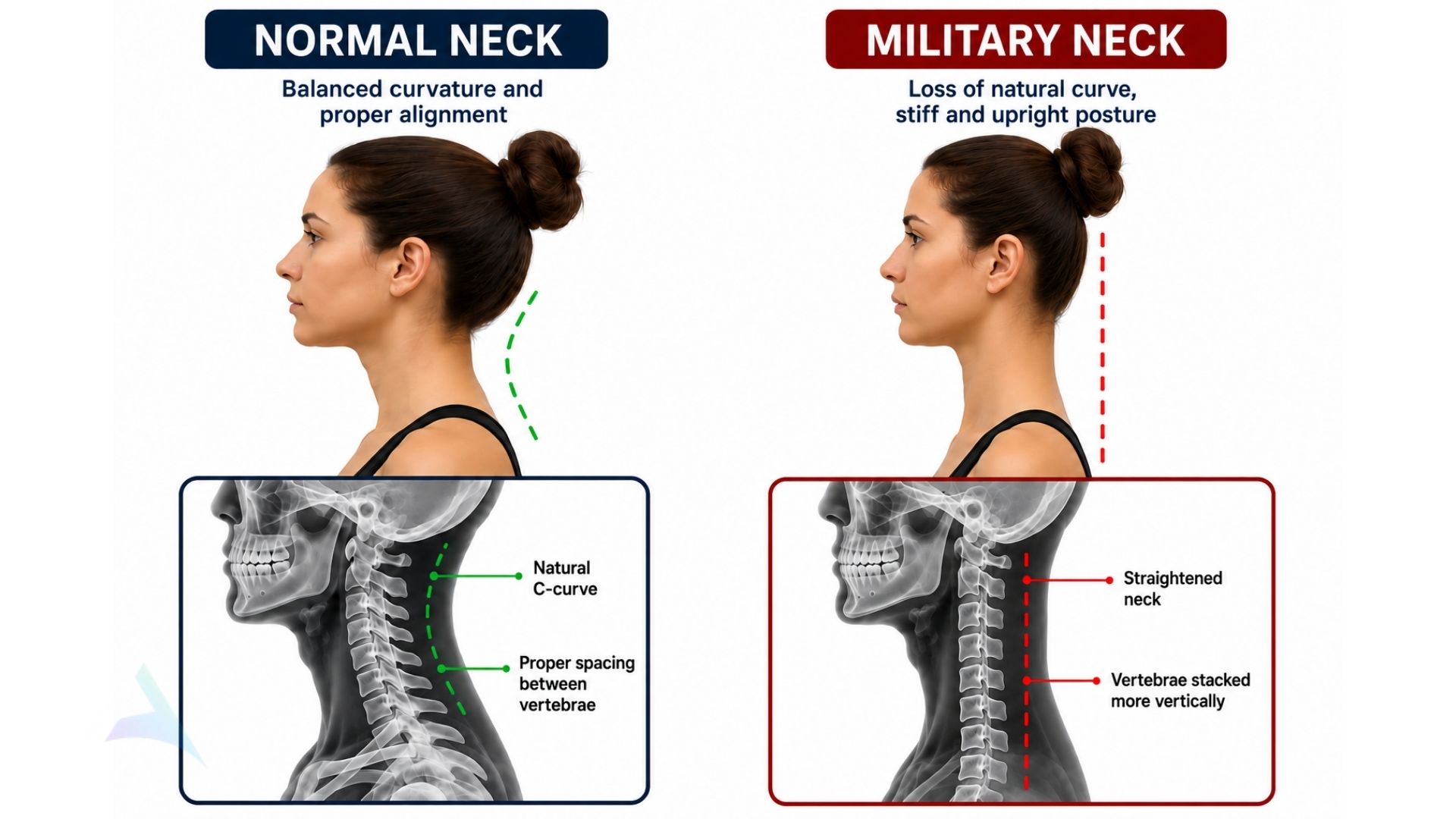
A healthy neck isn't straight. Viewed from the side, it has a gentle "C" curve that arcs slightly forward — that curve is called your cervical lordosis, and it's there for a reason. It acts like a spring, balancing the weight of your head and absorbing everyday stress.
"Military neck" is the nickname for what happens when that curve flattens out, straightens, or in some cases reverses. The name comes from the rigid, at-attention posture it can create, like a soldier standing very upright. You may also hear it called loss of cervical lordosis or cervical kyphosis. Whatever it's called, the core issue is the same: the neck has lost the natural curve it's supposed to have.
What Causes Military Neck
For most people, military neck isn't something they were born with — it develops over time. The most common causes are:
- Forward-head posture ("text neck"). Hours each day looking down at a phone, laptop, or desk gradually pulls the head forward of the shoulders. Over months and years, that steady strain can flatten the neck's natural curve.
- Injury or trauma. A car accident, a fall, a sports impact, or a whiplash injury can disrupt the curve — sometimes long before symptoms show up.
- Wear and tear over time. As the discs between the vertebrae change with age, the neck can gradually lose height and curve, tipping the head forward.
Often it's a combination — an old injury that never fully resolved, plus years of desk-and-phone posture on top of it.
Why the Curve Matters
Your head weighs roughly as much as a bowling ball, and your neck's curve is what lets you carry it with the least amount of strain. When that curve flattens, the balance changes. The muscles have to work harder to hold your head up, the joints and discs take on extra pressure, and the nerves threading through your neck can become irritated. It's why a straightened neck curve so often travels with chronic neck pain, headaches, and a stiff, restricted range of motion.

Symptoms to Watch For
Military neck shows up differently from person to person, but the common threads are:
- Neck stiffness and a reduced range of motion — turning your head feels tight or limited
- Chronic, nagging neck pain or tension across the shoulders
- Frequent headaches, often starting at the base of the skull
- Tingling, numbness, or aching that travels into the shoulders or arms
- A sense that your head sits "forward," or that good posture feels like hard work
If several of these sound familiar, your neck's curve is worth a closer look.
Where the Upper Neck Comes In
Here's the piece most people have never had explained to them. The atlas and axis — the top two bones of your spine — sit right at the base of the skull and set the tone for how the rest of the neck stacks beneath them. When these bones are misaligned, the muscles below often compensate, and that compensation can pull against your natural curve. It's worth understanding why these two small bones matter so much.
That's why, at Peak, we don't just look at the curve in isolation — we look at how the very top of your neck is aligned, because that alignment influences everything below it. If an atlas misalignment is part of your picture, gently addressing it may help your neck hold a healthier, more balanced position.
What the Research Shows — and What It Doesn't
I want to be straight with you here. The science that your neck's natural curve matters for healthy biomechanics is well established. The research on fully restoring a lost curve is more mixed — some approaches show measurable improvement in alignment and, more importantly, in how people feel, while results vary from person to person and no honest provider can promise a perfect X-ray.
So here's how I'd put it plainly: our goal isn't to chase a picture-perfect curve for its own sake. It's to improve how your neck is aligned and how it functions, so it moves better, carries your head with less strain, and hurts less. For some people that comes with a visible improvement in the curve; for others the bigger win is simply feeling and moving better. Care should always be personalized, and I'll never tell you we can guarantee a specific result.
The Upper Cervical Approach at Peak
Upper cervical care is a focused branch of chiropractic that works with the top of the neck — with no twisting, cracking, or popping. If your neck already feels stiff and sensitive, that gentleness matters a great deal.
Your visit begins with precise measurement, not guesswork. We use 3D CBCT imaging and functional nervous system testing to see exactly how your neck is aligned and where your atlas has shifted. From there we use low-force, specific methods such as the Blair upper cervical technique or the knee-chest technique to guide that bone toward its natural position — then give your body time to hold the correction so the muscles below can relax and rebalance.
A Whole-Person Plan for Your Neck
Your neck didn't lose its curve in a day, and supporting it is an everyday effort. These basics don't replace care — they give your neck a calmer, steadier environment to improve in:
- Mind your posture. The single biggest favor you can do your neck is to bring your screens up to eye level and take frequent breaks from looking down. Small, consistent posture changes take steady strain off the curve.
- Steady your magnesium. Magnesium supports healthy muscle and nerve function, which matters when tight neck muscles are part of the problem. You can find the practitioner-grade options we trust through our Fullscript dispensary, and I go deeper in our post on magnesium and nervous system health.
- Protect your hydration. The discs in your neck rely on good hydration to stay healthy. Our guide on why water is essential for the nervous system covers the why.
- Eat to lower the load. An anti-inflammatory way of eating can ease the strain on irritated joints and nerves. Start with our guide to anti-inflammatory foods for the nervous system.
- Guard your sleep. How you sleep can help or hurt your neck. A supportive pillow and mattress are a real investment — options like Saatva or Avocado are favorites, and you'll find other neck-friendly tools on our Amazon storefront.
None of these fix military neck on their own — they simply support the same goal: a neck that carries your head with less strain.
A Quick Word on Safety
Most neck stiffness and posture-related pain, while frustrating, isn't dangerous. But some symptoms deserve prompt medical attention — significant weakness or numbness in the arms or hands, loss of coordination or balance, problems with bladder or bowel control, or severe pain after a major injury. If that's you, please seek medical care right away. Upper cervical care is one part of a thoughtful plan, not a substitute for appropriate medical evaluation.
Looking for Military Neck Relief in Boise?
If your neck feels stiff, tired, and forward — especially if you've been told you've lost your cervical curve — the alignment at the very top of your neck is worth a closer look. I'd be glad to help you find out whether an upper cervical issue is part of your story. Learn more about why patients choose Peak, see that we proudly serve Boise and the Treasure Valley, and when you're ready, book your appointment with our team.
Frequently Asked Questions
Can military neck be corrected? For some people, the neck's alignment and curve can improve with consistent, targeted care — though results vary and no honest provider can promise a perfect X-ray. Our focus is on improving how your neck is aligned and how it functions, so it moves better and hurts less. Gently correcting an atlas misalignment is one part of that.
Is military neck serious? On its own it's usually not dangerous, but it does change how your neck carries the weight of your head, which can lead to ongoing pain, stiffness, and nerve irritation over time. That's why it's worth addressing rather than ignoring. Certain symptoms — significant arm weakness or numbness, or loss of coordination — do need medical evaluation first (see the safety note above).
What causes military neck? Most often it's a mix of forward-head posture from screens and desk work, an old injury such as whiplash, and normal wear on the discs over time. The result is the same: the neck loses its natural forward curve.
How is upper cervical care different from a regular adjustment for military neck? Traditional chiropractic uses general spinal adjustments; upper cervical care works only with the top of the neck and starts with precise 3D imaging — and it involves no twisting, cracking, or popping.
How long until I might notice a difference? Everyone is different. Some people notice less stiffness within the first few weeks, while lasting change usually comes with consistent care as the correction holds and the muscles rebalance. We'll set realistic expectations after your evaluation.