

What a Pinched Nerve Actually Is
Eight pairs of nerve roots branch off the spinal cord in your neck and travel out through small bony windows called foramina. Each one carries signals to a specific territory of the shoulder, arm, and hand. When one of those roots gets compressed or chemically irritated on its way out, the medical term is cervical radiculopathy. Most people just call it a pinched nerve.
The word "pinched" is a little misleading. Pressure is only half the story. Inflammation around the nerve root is often the bigger driver of pain, which is why symptoms can flare and settle without anything structurally changing.
The Symptoms People Actually Notice
Because each nerve root serves a specific area, symptoms tend to follow a stripe rather than spreading everywhere at once. Common patterns include:
- Sharp, burning, or electric pain running from the neck into the shoulder blade, arm, or hand
- Pins and needles, or numbness, in specific fingers rather than the whole hand
- Weakness in one particular movement, such as gripping, lifting the arm, or straightening the elbow
- A deep ache near the shoulder blade that will not release no matter how much you stretch
- Symptoms that get worse when you tip your head back and look up, or turn toward the painful side
- Relief when you rest your hand on top of your head, which takes tension off the nerve root
That last one is a genuinely useful clue. If lifting your arm overhead eases the pain, that points strongly toward a nerve root in the neck rather than a shoulder problem.
What the Research Says About Who Gets This and Why
Cervical radiculopathy affects roughly 83 people per 100,000 adults each year, with the peak showing up between ages 50 and 54. The lower neck takes the brunt of it: the C6 and C7 nerve roots account for more than 80 percent of cases.
The cause is less dramatic than most people expect. In the largest long-running population study, only about one in five cases involved a confirmed disc herniation. Close to 70 percent came down to spondylosis, disc changes, or a combination of the two. In plain terms, that means gradual wear at the joints and discs slowly narrowing the window a nerve root passes through. Only about 15 percent of people could point to a specific injury or strain that set it off.
There is genuinely encouraging news in that same research. Most cases improve without surgery. At long-term follow-up, around 90 percent of people were either symptom-free or only mildly limited. Current clinical guidelines reflect this and recommend conservative care first, before injections or surgery are considered.
Warning Signs That Mean Call a Doctor, Not a Chiropractor
This matters more than anything else on this page. Some symptoms suggest pressure on the spinal cord itself rather than a single nerve root, and those need prompt medical evaluation. Please contact your physician or seek urgent care if you notice:
- Clumsiness in your hands, such as dropping things or fumbling with buttons and zippers
- Changes in your walking, balance, or a sense that your legs feel unsteady
- Symptoms in both arms, or in your legs as well as your arms
- Any change in bladder or bowel control
- Weakness that is clearly getting worse week over week
- Fever, unexplained weight loss, or a history of cancer alongside new neck symptoms
Any responsible upper cervical practice will screen for these before anything else. If we see them at Peak, our job is to get you to the right physician quickly, not to start a care plan.
Why the Lower Neck Ends Up Bearing So Much Load
If the C6 and C7 roots cause most pinched nerves, a fair question follows: why does that part of the neck wear down in the first place?
Your head weighs somewhere around ten to twelve pounds. Its whole job is to balance on top of a fairly narrow column. When the head sits level and centered, that weight distributes reasonably well. When it does not, the segments below have to compensate, and they do it every hour of every day for years.
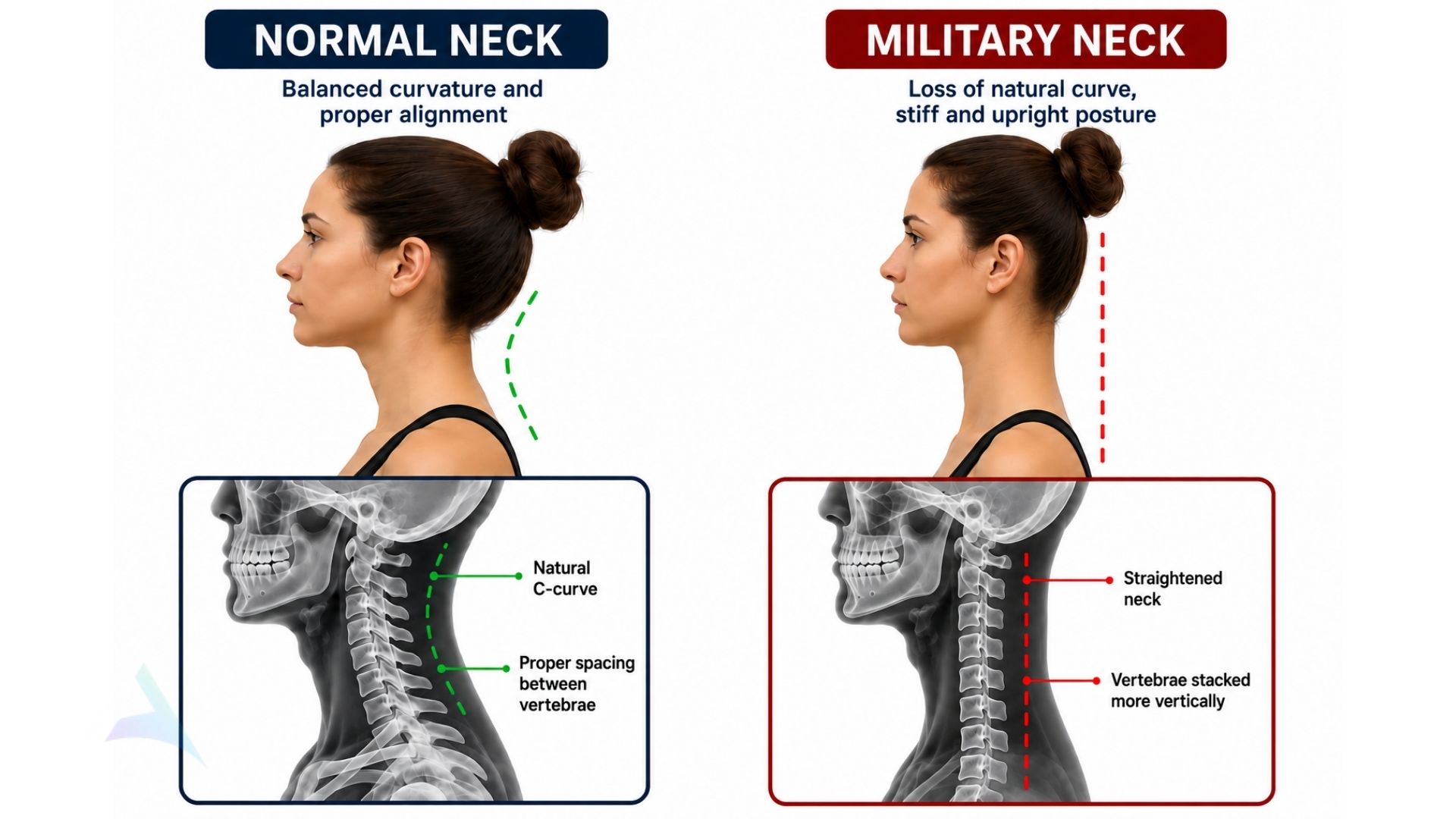
That is the same conversation underneath forward head posture and neck pain and behind the loss of curve people call military neck. It is also why an old whiplash injury from a fender bender on the Connector can quietly set the stage for arm symptoms that only show up a decade later.

Where the Top of the Neck Comes In
Let us be precise here, because this is where a lot of chiropractic marketing overstates its case.
The atlas (C1) and axis (C2) are not usually the vertebrae compressing the nerve root that makes your thumb go numb. That is happening further down. Adjusting the top of the neck does not directly open a foramen at C6 or C7, and we will not tell you that it does.
What the top two bones do control is how your head is positioned over everything below it. The atlas carries the skull. When it shifts out of alignment, the head no longer sits level, and the rest of the spine adapts to hold your eyes horizontal. That adaptation shows up as a shoulder that sits higher, a head that drifts forward, and uneven load through the lower neck year after year.
Our working model at Peak is that this sustained, uneven loading is one contributing factor in why some necks develop the joint and disc changes that eventually crowd a nerve root, and why symptoms on one side can be so stubborn. We want to be clear that this is a model grounded in biomechanics, not a proven chain of cause and effect. The research on upper cervical care specifically for nerve root symptoms is limited and largely case-based. Anyone claiming otherwise is going further than the evidence allows.
Why Gentle and Non-Twisting Matters Here More Than Anywhere
There is one point where our approach is not a philosophical preference but a practical one.
The standard clinical test for a pinched nerve in the neck is the Spurling's maneuver. The examiner tips the patient's head back, bends it toward the painful side, rotates it that direction, and applies gentle downward pressure. If symptoms shoot down the arm, the test is positive — because that exact combination of movements narrows the opening the nerve root travels through.
Now consider what that means. Extension plus rotation is precisely the position that provokes an irritated nerve root. So when a nerve root is already inflamed, a forceful rotational adjustment is asking the neck to move through the very motion that reproduces the symptom.
Our gentle alignment approach involves no twisting, no popping, and no forceful rotation of the head. Patients tell us often that this is what brought them in. As one Boise patient put it in her review, she was scared of being twisted and popped, and that is not part of what we do.
How We Evaluate a Pinched Nerve at Peak
Before any care begins, we need to know whether we are the right place for you. Our evaluation process includes:
- A full history, including any accidents, falls, or injuries you may have written off years ago
- A neurological screen of reflexes, strength, and sensation to map which nerve root is involved and to rule out cord-level warning signs
- 3D CBCT imaging so we can see your actual anatomy rather than working from an average
- Functional nervous system testing to establish an objective baseline we can measure against later
If that workup points to something outside our scope, we say so and help you get to the right provider. Sometimes the honest answer is that you need a physician, a neurologist, or an imaging study first, and we would rather tell you that on day one than three months in.
What Care Looks Like, and What It Cannot Promise
When upper cervical care is appropriate, the goal is straightforward: restore the head-to-neck relationship so the segments below are not fighting an uneven load, and give the nervous system a better environment to settle in.
What we will not tell you is that an adjustment cures a herniated disc or reverses arthritic change. It does not. What gentle care may reasonably support is a reduction in the mechanical stress traveling through an already irritated area, alongside the natural improvement that most cases of cervical radiculopathy show over time anyway. Progress is measured by your symptoms and your objective testing, not by a script.
Supportive Habits Between Visits
What you do the other 23 hours a day matters as much as anything that happens in our office.
Sleep position is usually the first thing to address, because most people wake worse than they went to bed. A pillow that lets the head drop or tips the neck sideways keeps a nerve root compressed for seven hours straight. Dr. Kyara often talks patients through how a properly fitted cervical pillow supports neck alignment, and a few of the supports she suggests for home are gathered on our Amazon storefront.
Beyond sleep, a few things consistently help:
- Raise your screen. Looking down for hours is the single most common aggravator we see.
- Avoid extended overhead work and prolonged looking up while symptoms are active.
- Keep moving gently. Complete rest tends to stiffen things rather than settle them.
- Support your body's inflammatory balance through anti-inflammatory foods, since chemical irritation is a real part of nerve pain.
- Ask about magnesium and nervous system support if muscle guarding is keeping you up at night. Dr. Kyara can build a plan through our Fullscript dispensary if it makes sense for you.
For patients with a lot of protective muscle guarding through the shoulder and shoulder blade, Dr. Kyara frequently suggests pairing care with skilled soft-tissue work, and often points people toward Cohen Injury Massage here in the Treasure Valley.
Getting Answers in Boise
If you have been trading one flare for another, or you are being told to wait it out without anyone explaining why the nerve is irritated in the first place, a precise evaluation is a reasonable next step. We serve Boise, Meridian, Eagle, and the surrounding Treasure Valley from our office in Garden City.
You will leave your first visit knowing what we found, whether upper cervical care is a sensible fit for your situation, and what we would recommend if it is not. Book an appointment or call (208) 901-0327 to get started.
This article is for educational purposes and is not a substitute for individualized medical advice. If you are experiencing progressive weakness, hand clumsiness, balance changes, or any change in bladder or bowel function, please seek medical evaluation promptly.
Frequently Asked Questions
Can a chiropractor help with a pinched nerve? Research on manual care for pinched nerves shows short-term improvements in pain and movement for many people, though the evidence is limited and results vary. What I can tell you is how we approach it: precise 3D imaging first, gentle no-twist corrections second, and honest guidance if your case needs medical care instead.
How long does a pinched nerve take to heal? Most settle within days to a few weeks with conservative care. If yours has lingered past that, keeps recurring, or is getting worse, that's the signal to have it evaluated rather than waiting it out.
Can a pinched nerve heal on its own? Often, yes — especially a first episode with a clear trigger. The ones that deserve attention are the repeat offenders: recurring flares usually mean the underlying mechanics haven't changed.
Is it safe to adjust a neck with a pinched nerve? This is exactly why we practice upper cervical care: there's no twisting, cracking, or popping involved. We work from precise imaging with low-force, specific corrections — an approach designed for necks that are already sensitive. And if imaging suggests your case needs medical evaluation first, we'll say so.
Should I see a doctor or a chiropractor first? If you have any of the red flags above (worsening weakness, spreading numbness, bladder/bowel changes, major trauma), a medical doctor — promptly. Otherwise, starting conservatively is consistent with standard guidance, and we coordinate with medical providers when a case calls for it.